
Resource Hubs: For more long-form science features, browse the Growth List blog. For weekly newly-funded startup data, see Growth List.
In 1971, NASA’s Mariner 9 slipped into orbit around Mars in the middle of a planet-wide dust storm and waited. When the dust began to thin, the first high places to show through were the Tharsis volcanoes, including the bright feature Earth-based astronomers had known since Giovanni Schiaparelli’s maps as Nix Olympica, the Snows of Olympus.
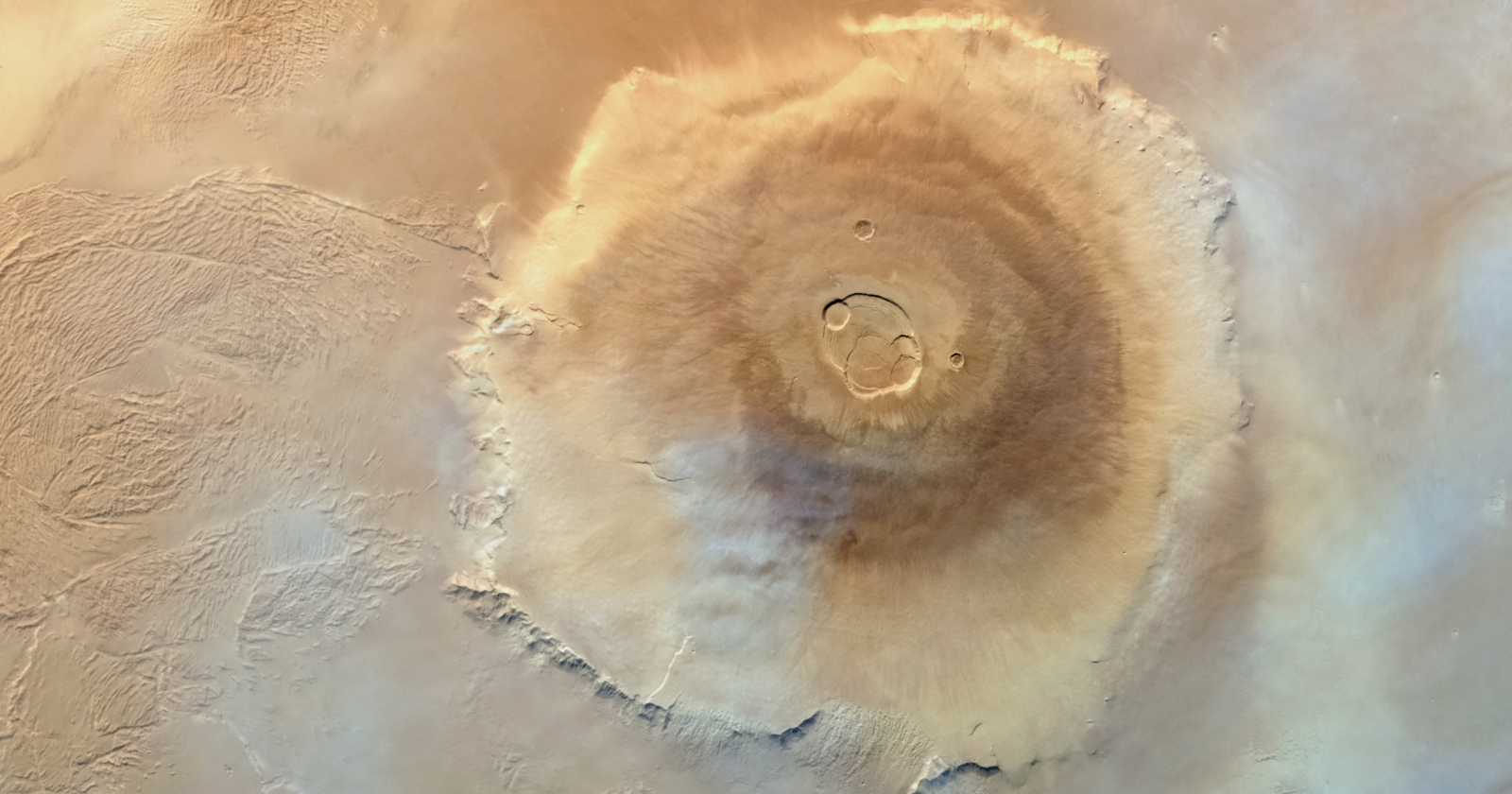
What Mariner 9 saw was not a snowfield. It was the summit region of Olympus Mons, a shield volcano so wide that its base would cover an area roughly the size of Arizona, and so tall that its summit stands more than 21 kilometres above the Martian datum.
A mountain you would never feel beneath you
The base of Olympus Mons is about 370 miles across. The summit rises about 13 miles above the surrounding plains, more than twice the height of Mount Everest above sea level, and close to three Everests if measured against the mountain’s local relief.
Put those numbers together and the shape becomes stranger than the height. The average flank slope is only a few degrees, so a person standing near the foot of Olympus Mons would not see a mountain in front of them. They would see ground that looked almost flat, with the summit hidden beyond the curve of Mars.
Why Mars builds volcanoes this big
Olympus Mons is a shield volcano, the same broad family as Mauna Loa in Hawai’i. Shield volcanoes form when low-viscosity lava travels far before cooling, stacking thin sheets of basaltic rock into a wide, shallow dome rather than a steep cone.
On Earth, plate tectonics limits that growth. The Hawaiian volcanoes form as the Pacific Plate slides over a hot spot, so each volcano is carried away from its magma supply before it can keep building forever.
Mars does not have active plate tectonics in the same way. A volcanic vent can stay parked over the same deep source for immense stretches of time, while lower gravity and a thin atmosphere let lava flows and ash behave differently from their Earth equivalents.
The volume problem beneath Tharsis
Olympus Mons is not just tall. It is vast. The volcano covers roughly 300,000 square kilometres, close to the area of Arizona, Italy, or the Philippines, and its outer edge is marked by an escarpment that rises for kilometres in places.
The feature was first named Nix Olympica because early telescopic observers could only map brightness, not topography. A USGS geologic map of the Olympus Mons region notes that Schiaparelli’s 1879 name was based on the albedo feature, and that Mariner 9 images in 1971 showed the bright patch coincided with a giant shield volcano.
That size creates a physics problem. A pile of volcanic rock this large should weigh heavily on the Martian crust, yet the broader Tharsis region is high, warped and surrounded by unusual gravity signatures.
In 2024, Bart Root of Delft University of Technology and colleagues presented gravity modelling at the Europlanet Science Congress that used satellite orbit deviations together with NASA InSight constraints on the Martian crust. Their model points to a low-density mass about 1,750 kilometres across, roughly 1,100 kilometres beneath the surface, giving Tharsis an upward push.
“The NASA InSight mission has given us vital new information about the hard outer layer of Mars. This means we need to rethink how we understand the support for the Olympus Mons volcano and its surroundings,” Root said in a Europlanet release. “It shows that Mars might still have active movements happening inside it, affecting and possibly making new volcanic features on the surface.”
Frost on a mountain that should not have any
In 2024, researchers using the European Space Agency’s ExoMars Trace Gas Orbiter and Mars Express reported something that contradicted decades of expectation: water frost forms on the summit calderas of the Tharsis volcanoes, including Olympus Mons, briefly around Martian sunrise.
The frost is extremely thin, about the width of a human hair, and it vanishes after sunlight reaches the caldera floor and rim. But the area involved is enormous, and the researchers estimated that about 150,000 tonnes of water may condense as frost across the volcanoes during colder Martian seasons.
The finding, published in Nature Geoscience, matters because these volcanoes sit near the Martian equator. Sunshine and thin air were expected to make frost there unlikely, but the calderas appear to create their own cold morning traps for water vapour.
The caldera, the cliff and the canyon next door
The summit caldera of Olympus Mons is not a neat bowl. It is a nested complex of collapsed pits dozens of miles across, made as magma chambers emptied and their roofs fell inward in stages.
The outer edge is even stranger. Olympus Mons ends in a near-continuous cliff, or basal escarpment, that rises for kilometres around much of the volcano, unlike the gentle margins people expect from shield volcanoes on Earth.
Geologists have proposed several explanations for that cliff. One involves giant landslides off the volcano’s flanks. Another involves ancient ice or glaciers helping to erode and sharpen the boundary.
Olympus Mons also sits in a crowded neighbourhood. Tharsis holds other giant shield volcanoes, including Ascraeus Mons, Pavonis Mons and Arsia Mons, and the whole bulge has warped the Martian crust on a planetary scale.
To the southeast lies Valles Marineris, the canyon system revealed by Mariner 9 and named for the mission. NASA notes that Mariner 9 mapped 85% of the Martian surface and returned more than 7,000 images, including Olympus Mons and Valles Marineris.
What you would actually see
Stand on the caldera floor at Martian sunrise and the scene would be almost silent. The sky would be dusty and thin, the rocks would briefly flash with pale frost, and the terraced caldera walls would rise around you before the sunlight erased the ice.
The atmosphere around you would still be mostly carbon dioxide and far too thin for a human lung. NASA describes Mars as a cold desert world with a very thin atmosphere, with average surface pressure less than 1% of Earth’s sea-level pressure, and Olympus Mons rises above much of even that sparse air.
From the rim, the view would not resemble a mountain overlook on Earth. The volcano is so broad and gently sloped that the planet bends away beneath it, and the horizon would be shaped by both Mars’s curvature and the volcano’s own immense flank.
Mariner 9 sent its early Mars data back through the Deep Space Network at a maximum planned rate of 16,200 bits per second when transmitting to the 210-foot Goldstone antenna. The largest volcano in the solar system arrived on Earth slowly, line by line, from a bright patch once called snow into a summit of rock.