
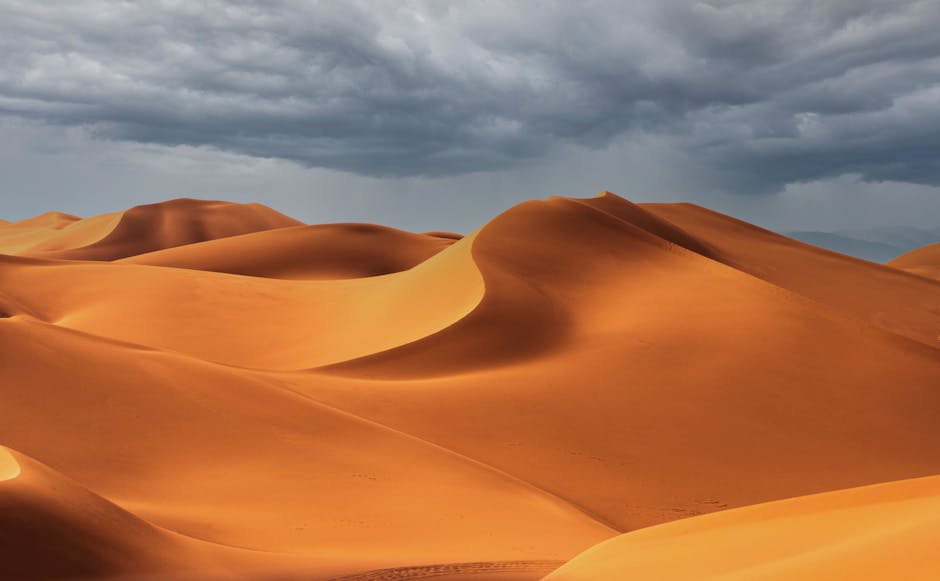
Every year, a tan veil of Saharan dust crosses the Atlantic and settles over the Amazon basin, carrying roughly 22,000 tons of phosphorus into a rainforest whose own rain is constantly washing that nutrient away.
The numbers are startling because the map looks impossible. One system is the largest hot desert on Earth. The other is the largest tropical rainforest. Between them sits an ocean.
Yet NASA researchers using CALIPSO satellite data estimated that winds carry about 182 million tons of Saharan dust westward each year, and that about 27.7 million tons of it falls over the Amazon basin.
That dust is not just grit. It contains phosphorus, one of the nutrients Amazon plants need to build proteins, move energy through cells, and keep new growth moving through soil that is constantly being rinsed by rain.
The famous version of the story points to the Bodélé Depression in Chad, a dried lake bed where old biological sediments are rich in phosphorus. That version is partly true, but the newer science is more complicated.
The rainforest is green, but its soil is hungry
The Amazon looks like a self-feeding machine. Leaves fall, fungi and insects break them apart, roots take the nutrients back up, and the forest keeps its enormous green canopy alive.
That loop is fast. It is also leaky.
Heavy rain and flooding wash phosphorus out of the basin and into streams and rivers. NASA described the process as nutrients draining from Amazon soils like water from a slowly leaking bathtub.
Unlike nitrogen, phosphorus cannot simply be pulled from the air by living systems. It mostly begins in rock, moves through weathering and soil, and can be lost from land when water carries it away.
That is why the dust matters. The phosphorus delivered by Saharan dust, estimated at about 22,000 tons per year, is roughly comparable to the amount the Amazon loses to rain and flooding, according to the 2015 satellite-based assessment published in Geophysical Research Letters.
NASA measured the dust in three dimensions
The 27.7 million-ton figure comes from NASA’s CALIPSO mission, short for Cloud-Aerosol Lidar and Infrared Pathfinder Satellite Observation.
CALIPSO carried a lidar instrument that sent pulses of light into the atmosphere and measured what bounced back from particles suspended in the air. That let researchers distinguish dust from other aerosols and estimate how much material was moving at different altitudes.
NASA’s 2015 summary of the work reported that about 182 million tons of dust leave the western edge of the Sahara each year. About 132 million tons remain airborne near the eastern coast of South America, and about 27.7 million tons fall over the Amazon basin.
The transport is not steady from year to year. The same NASA account noted an 86 percent difference between the highest year in the data set, 2007, and the lowest, 2011.
That variability matters because the Amazon’s phosphorus replacement is not a permanent pipe. It is an atmospheric habit, shaped by winds, rain, source regions, and the height at which dust rides across the Atlantic.
The Bodélé Depression made the story famous
The Bodélé Depression sits in northern Chad, northeast of Lake Chad, between the Tibesti and Ennedi mountain ranges.
Its surface contains sediment from older lake environments. NASA has described dust from the Bodélé as carrying rock minerals composed of dead microorganisms loaded with phosphorus.
The geography helps make the place unusually dusty. The surrounding mountains funnel winds across the depression, turning the old lake bed into one of the world’s strongest mineral dust sources.
An earlier study described the Bodélé as a single Saharan source that could provide about half of the mineral dust reaching the Amazon, despite occupying only a tiny fraction of the Sahara’s area. The University of Maryland’s 2015 account of the CALIPSO work also highlighted the Bodélé as a key phosphorus-rich source for Amazon-bound dust.
That is the cinematic version: a dry lake bed in Chad feeding a rainforest across the ocean.
Newer work complicates the single-source claim
The problem is that dust origin is hard to prove once the particles have crossed thousands of miles of atmosphere.
In 2020, NASA’s Earth Observatory summarized newer research indicating that much of the Bodélé dust may settle over Africa or be washed out before reaching South America. That work pointed instead to El Djouf, a desert region in Mauritania and Mali, as a preferred source for dust that actually reaches the Amazon.
The paper behind that update, published in Geophysical Research Letters, argued that the Bodélé had long been treated as the leading source, but that observation-constrained trajectory analysis favored El Djouf for intercontinental transport across the Atlantic.
That does not make the older Bodélé story worthless. It makes the system more interesting.
The Amazon is still receiving Saharan phosphorus. The Bodélé is still an extraordinary dust source. But the cleanest current version is not that one Chadian depression alone keeps the rainforest alive. It is that North African dust, from multiple source regions, helps replace a nutrient the Amazon is constantly losing.
The dust rides a moving layer of dry air
Saharan dust crosses the ocean inside the Saharan Air Layer, a hot, dry, dusty mass of air that forms over North Africa and moves westward over the Atlantic.
During the Atlantic hurricane season, dust plumes often become visible on satellite imagery as pale clouds stretching toward the Caribbean and the Americas. WLRN, citing Florida Public Radio Emergency Network weather reporting, describes the Saharan Air Layer as sitting roughly between half a mile and 3.5 miles above the surface.
Some dust falls into the Atlantic. Some reaches the Caribbean. Some reaches Florida. A measurable fraction settles over the Amazon, where its phosphorus becomes part of a very old nutrient exchange between desert, ocean, rain, and forest.
The journey also cuts against the way people usually imagine ecosystems. The Amazon is not sealed inside its own borders. Its fertility is tied to winds over Africa, rainfall in the Sahel, and the dust sources exposed by vanished lakes and ancient sediments.
A forest fed by something it will never see
The astonishing part is not just the distance. It is the balance.
The Amazon loses phosphorus through rain and flooding. Saharan dust brings in about the same order of phosphorus from outside the basin. Remove that input over long enough timescales, and the rainforest’s nutrient budget would be pushed toward depletion.
The original 2015 paper put the danger in terms of decades to centuries: without the phosphorus input from African dust, hydrological loss would greatly deplete the Amazon soil phosphorus reservoir and affect the forest’s health and productivity.
So the final image is not a single heroic lake bed saving a rainforest by itself. It is stranger than that: dust rising from North African drylands, crossing the ocean in a high, invisible river of air, and falling into a forest where every storm is already washing tomorrow’s nutrients away.