
Explore more from the Growth List Resource Hubs: curated reads on startup data, founder behaviour, and the strange edges of human experience that intersect with how we work and build.
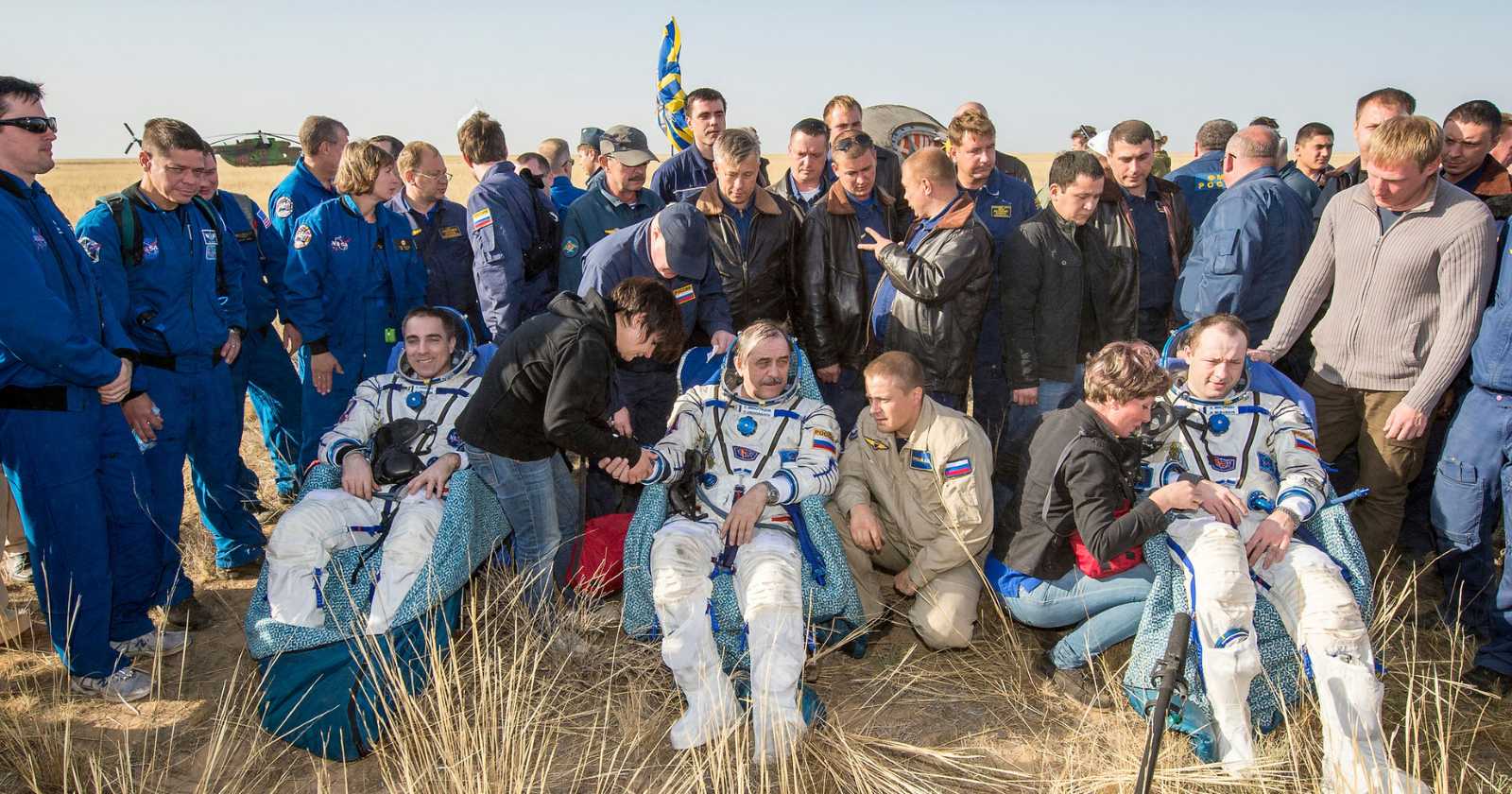
Doug Wheelock spent time aboard the International Space Station, and when he climbed out of his Soyuz capsule onto the Kazakh steppe, the thing that floored him was not gravity or sunlight. It was the smell of dirt and dry grass. He has described the moment in interviews and public talks as a sensory wall, a scent so dense after months of recycled cabin air that he sank into it.
The capsule had landed in a flat, brown stretch of central Asia in late autumn. No flowers. No forest. Just cold soil, frost-burnt steppe grass, and the diesel of the recovery helicopters.
And that was enough to overwhelm him.
The smell of Earth, after six months without it
Wheelock has told the story on NASA broadcasts and in astronaut psychology coverage for years. The detail he keeps returning to is not the view of Earth from orbit. It is the absence, up there, of anything that smells like a planet. The station smells of metal, plastic, sweat, electronics, and the faint ozone-and-gunpowder note crews report after spacewalks, when suits are repressurised and the vacuum-exposed fabric outgasses into the airlock.
There is no soil on the ISS. No rain on warm pavement. No pine. No rotting leaves. No wet dog.
For months, Wheelock’s olfactory system had almost nothing to do.
Why the nose hits the brain harder than the eyes
Of the five senses, olfaction is the only one wired directly into the limbic system, the cluster of structures that handles emotion and memory. The limbic system is a constellation of cortical and subcortical nodes including the hippocampus, amygdala, and orbitofrontal cortex, all bound together by recursive loops that fuse sensory input with affective valence.
Sight has to pass through the thalamus first. Sound takes a similar detour. Smell does not. A scent molecule lands on receptors in the nasal epithelium, fires the olfactory bulb, and the signal arrives in the emotional and memory regions before the conscious brain has labelled what it just smelled.
That is why a single whiff of someone’s perfume or a school cafeteria can collapse twenty years in a second.
Psychiatrist Richard Restak, writing in Psychology Today, notes that olfactory emotions are “more intense, vivid, emotionally charged, and experiential” than memories triggered by any other sense. The odorant transports the person back to the scene of first exposure. Proust and the madeleine. Wheelock and the steppe.
What sensory deprivation does to a returning brain
Wheelock’s response is consistent with what researchers see in much shorter and milder forms of sensory deprivation here on Earth.
When Kiana Aran, a bioengineering professor at UC San Diego, spent time alone in a pitch-dark cave chamber in Poland, her saliva proteomics showed a measurable rise in taste receptor levels within the first hours. Aran also noticed food flavours and textures becoming more intense almost immediately. Her body began upregulating the senses she still had access to.
This is the brain doing what it does. Strip a channel of input and the system reallocates. Bring the input back and the rebound is sharp.
Aran was in the dark for five days. Wheelock was without dirt, plants, weather, animals, food smells beyond a thermostabilised pouch, and the chemical noise of a living planet for months.
The Orfield chamber and the body’s quiet noise
The closest civilian analogue might be the anechoic chamber at Orfield Laboratories in Minneapolis, one of the quietest places on Earth. Founder Steven Orfield describes the experience: “When it’s quiet, ears will adapt. The quieter the room, the more things you hear. You’ll hear your heart beating, sometimes you can hear your lungs, hear your stomach gurgling loudly. In the anechoic chamber, you become the sound.”
Strip away the ambient and the body becomes the signal.
In orbit, the smell of the spacecraft itself eventually becomes invisible to the crew. The receptors habituate. They stop firing for cabin air because cabin air is constant. What remains is a low background hum of nothing, sensorially speaking, in the channel that connects most directly to emotion and memory.
What Wheelock walked into
The Soyuz capsule landed in northern Kazakhstan. Recovery footage shows the standard scene: scorched capsule, flight surgeons, blankets, the crew lifted out one at a time and propped in folding chairs on the steppe. Wheelock came out third.
Months of microgravity had already done its work on his vestibular system. His inner ear no longer knew which way was down. His cardiovascular system was recalibrating. His bones were lighter.
And then his nose started working again.
The receptors in his nasal epithelium, which had spent months smelling almost nothing organic, fired into a freshly thawed November landscape. Soil bacteria. Decomposing grass. Geosmin, the compound that gives wet earth its smell, detectable by the human nose at extraordinarily low concentrations.
The signal went straight to his limbic system. The limbic system did what it does.
Why other astronauts report the same thing
Wheelock is not an outlier. Astronauts returning from extended missions may experience intensified sensory perceptions due to the sensory-deprived environment of space, similar to how sensory deprivation can heighten subsequent sensory responses.
The detail varies. The mechanism does not.
What changes is the baseline. Spend long enough in an environment with almost no olfactory information and the first hit of a planet’s worth of volatile organic compounds is, neurologically, the equivalent of a flashbulb in a dark room.
The training that doesn’t prepare you for it
Astronauts train for almost everything. Centrifuge runs for re-entry g-forces. Pool sessions for spacewalk choreography. Survival drills for off-nominal landings in forest or sea. Russian language for Soyuz operations.
Nobody trains them for the smell of grass.
Joy Mala, a curator and analytical chemist in Nairobi who runs olfactory art workshops, told Standard Media that scent “bypasses intellectual interpretation and transforms into feeling.” Her participants regularly find themselves crying over a blotter strip dipped in a single note that reminds them of a grandmother’s kitchen.
An astronaut returning from months in a sealed metal can is, in olfactory terms, a Mala workshop participant being handed the entire planet at once.
What the limbic loop actually does in that moment
The hippocampus, sitting next door to the olfactory processing regions, is also where memory formation begins. Neuroscientists have long suspected that the physical closeness of these structures is not an accident. Volunteers who learned word lists while exposed to rosemary or peppermint recalled the words better when the same scent was reintroduced, even during sleep. The odour and the memory consolidate together.
For Wheelock, the scent of the steppe was not a neutral data point. It was the keychain for every memory he had of being on Earth. Childhood. Family. Backyards. Walking the dog. Every scene tagged with “outdoors” in his hippocampus got pinged simultaneously.
That is a lot of signal to process while also trying to stand up in 1g for the first time in months.
The recovery teams know
The crews who meet Soyuz capsules on the steppe have seen it enough times to expect it. Hot tea, blankets, and a chair come out before anyone asks the returning astronaut to walk. The chair is partly for vestibular reasons. It is also, in practice, for the moment when the nose catches up with the rest of the body and the returning crew member needs to sit down and just breathe.
Geosmin. Petrichor. Cold grass. Diesel from the helicopter. Sweat from the flight surgeon. Vodka, sometimes, in the Russian tradition.
A planet’s worth of chemistry, arriving all at once, in the one sensory channel that does not pass through the conscious mind before it reaches the heart.
Wheelock has been back on Earth for years now. The receptors have long since habituated. Grass smells like grass again. But he still talks about that first lungful on the Kazakh steppe, the way someone might talk about a song they heard once and can no longer find. The fact remains in the logbook. The sensation, by its nature, does not.