
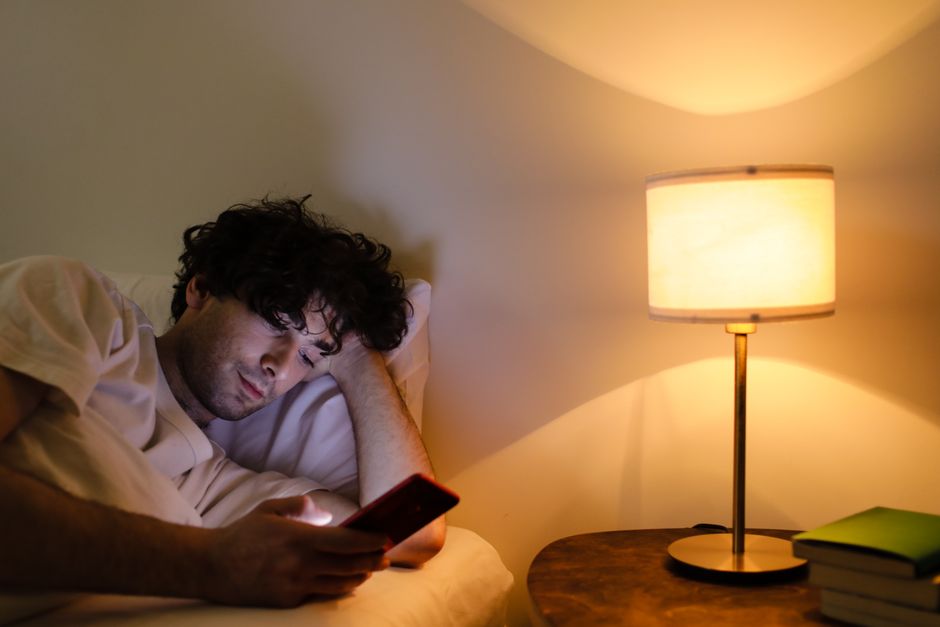
In late May 2026, Dr. Kunal Sood — an anaesthesiologist and interventional pain medicine physician — posted a short Instagram video about what actually happens inside the body in the first ten minutes after waking, when most people reach for the phone before they’re even fully upright. The Indian Express summarised his clinical framing a few days later. The core observation was almost mundane in how plainly he put it. “Notifications are designed to interrupt attention and signal that something needs a response,” Sood said. “Research shows they can affect cognitive control and attention even without fully engaging with the phone.”
The instinct, when someone you know mutes their phone and leaves it face-down all day, is to read it as a step back from the world — antisocial, evasive, or the early sign of someone retreating. The research on what notifications actually do to the body suggests something quieter and more specific is happening. The people who silenced their phones years ago and never turned the sound back on aren’t hiding. They’ve worked out, often without putting it into words, that the nervous system was not built to absorb a hundred small interruptions a day without paying for it somewhere.
What a notification actually is, biologically
A buzz is not neutral information. It’s a stimulus the brain has to triage — friend or threat, urgent or ignorable, deal with now or later. The sound alone is enough to spike alertness. You don’t have to read the message to pay for it.
A 2022 study in PLOS ONE, led by Joshua Upshaw at the University of Arkansas, measured this directly. Participants completed an attention task while smartphone notification sounds played in the background. Reaction times slowed even when no actual notification needed handling, and the electrophysiological signature — a larger N2 ERP on smartphone-sound trials — suggested participants were burning extra cognitive control just to keep going. People with higher self-reported smartphone use paid more. The ping was costing something whether or not it was checked.
Multiply that by the average phone’s daily output — pings from couriers, group chats, calendar apps, two-factor codes, a stranger liking a comment from 2019 — and the body is being asked to perform threat assessment dozens of times an hour. The sympathetic nervous system, which evolved to handle occasional sprints from danger, ends up idling at a higher RPM all day.
People who keep their phones on silent have usually figured this out without reading a single neuroscience paper. They’ve noticed they feel calmer. They’ve noticed they sleep better. They’ve noticed that the absence of the sound is not the absence of connection; it’s the absence of being yanked.
The morning version of the same problem
The most concentrated example happens in the first ten minutes after waking. Cortisol, the body’s main stress hormone, rises sharply in that window — it’s a phenomenon called the cortisol awakening response (CAR), characterised in a 2007 sleep-laboratory study by Ines Wilhelm, Jan Born and colleagues in Psychoneuroendocrinology as a phasic psychophysiological process specific to the sleep-wake transition, distinct from the slower circadian rise that happens overnight. In plainer language: the chemistry of waking up is not the chemistry of being awake. It’s its own thing, and it lasts about half an hour.
Sood, in the same Instagram post and the Indian Express summary, described the cost of layering phone use on top of that rise. “Morning phone use exposes the brain to notifications, social comparison, information overload, and attention switching during the transition from sleep to wakefulness,” he said. Adding emails and news to a system already mid-spike, he noted, can “increase sympathetic nervous system arousal and mental tension.”
Silent-phone people often, without articulating it, treat the first hour of the day as something they own. They make coffee. They look at a window. They give the cortisol curve a chance to do its job without a stranger’s opinion in the middle of it.
The Monday effect, and why ambient stress lingers
A 2025 study led by Professor Tarani Chandola at the University of Hong Kong, published in the Journal of Affective Disorders and summarised by HKU in its announcement of the work, found something striking about how social rhythms get under the skin. Analysing data from more than 3,500 older adults in the English Longitudinal Study of Ageing, the team showed that participants who reported feeling anxious on Mondays had roughly 23% higher cortisol levels in hair samples — a measure that reflects two to three months of hormonal averaging — than those who felt anxious on other days. The effect held for retirees too, with no commute or boss to dread.
“Mondays act as a cultural ‘stress amplifier,'” Chandola said. “For some older adults, the week’s transition triggers a biological cascade that lingers for months. This isn’t about work — it’s about how deeply ingrained Mondays are in our stress physiology, even after careers end.”
The relevance to a silent phone is simple. If a single cultural cue — the start of the week — can embed itself in the body’s stress response for months, the cumulative pressure of hundreds of daily pings is unlikely to be benign. The hypothalamic-pituitary-adrenal axis, which governs cortisol, doesn’t distinguish between meaningful interruptions and a notification that someone has updated their Spotify playlist. It just registers something requires attention, and adjusts.
Why silence isn’t the same as withdrawal
The most common misreading of the silent-phone habit is that it’s a step away from intimacy. In practice, the opposite is usually true. People who silence their phones tend to be more present with whoever is in the room, more deliberate about returning calls, more capable of sustained conversation. What they’ve removed is not connection but the false urgency of pseudo-connection — the way a vibrating phone in a pocket can hijack a dinner without anyone actually saying anything important.
Mark Travers, a psychologist who writes regularly for Forbes alongside Psychology Today and CNBC, often returns to a related point about boundaries: they aren’t primarily about assertiveness, but about how individuals absorb other people’s emotional states, manage conflict, and rely on predictable structures for a baseline sense of safety. A silent phone fits cleanly into that framing. It behaves like a structural boundary — a way of controlling when and how external demands reach you, rather than leaving that question to whoever has your number.
For people who tend to take on the emotional states of those around them, ambient interruption is more expensive than it is for others. Every notification carries the possibility of someone else’s distress, someone else’s need. Silencing the phone, in that light, is not avoidance. It’s a containment strategy that lets them be useful to the people they care about without dissolving into everyone’s mood at once.
The cortisol question, and the teenagers
The clearest evidence that chronic stimulation has biological consequences comes from work on adolescents, whose cortisol systems are still calibrating. Bruce McEwen and John H. Morrison’s 2013 review in Neuron, on the brain’s response to stress over the life course, set out the broader machinery: chronic stress doesn’t just feel bad; it physically remodels the prefrontal cortex, the region responsible for judgement and impulse control, with sex- and age-specific patterns of dendritic atrophy and recovery. The plasticity cuts both ways. The damage isn’t necessarily permanent, but it isn’t negligible either.
Adults aren’t immune to the same machinery. The HPA axis doesn’t switch off at 25. It just becomes harder to notice the slow drift, because the baseline shifts incrementally. People who silence their phones often describe a similar pattern of realisation: they didn’t know how wound up they were until the buzzing stopped.
The social cost, honestly named
There is a real cost. People who keep their phones on silent miss things. They miss the friend who needed a fast answer about dinner plans. They miss the courier at the door. They occasionally miss something that mattered. The reframe isn’t that silence is costless — it’s that the cost of the alternative, paid in cortisol and attention and slow erosion of focus, has historically been invisible, and is no longer.
There’s also a generational asymmetry worth naming. For people raised on landlines, an unanswered call still carries the weight of refusal. For people raised on smartphones, an unanswered call is barely a category — texts came first, calls are an escalation. The silent-phone habit reads differently across that line. To one group it looks like rudeness; to the other it looks like basic hygiene.
What the habit is actually protecting
Strip the behaviour back to its function and it’s not really about phones. It’s about whose rhythm gets to set the day. A vibrating phone is, in effect, a delegation of that rhythm to whoever has your number, plus every app you’ve ever installed, plus every algorithm that’s learned when you’re most likely to click. The silent phone is a small, daily revocation of that delegation.
The point about emotional absorption is worth returning to. The people most vulnerable to ambient interruption are often the ones who care most — the ones who feel the weight of other people’s needs as if they were their own. For them, a silent phone isn’t a wall against intimacy. It’s the architecture that makes intimacy sustainable. Without it, every casual notification carries the moral weight of an obligation, and the day fractures into a hundred small acts of unfinished care.
The cardiovascular stakes raised by Chandola’s Monday study give the whole thing a longer arc. If a weekly cultural cue can leave cortisol elevated for months, the slower, more constant pressure of always being reachable is unlikely to leave the body untouched over decades. The people who turned the sound off years ago and never turned it back on may simply be running a quieter experiment, with their own physiology as the data.
Late evening, the phone face-down on a side table, the room genuinely quiet — no glow, no hum, no small bright rectangle asking for a piece of attention that isn’t urgent and never was. The calls that matter will come tomorrow. The body, for the first time in hours, is not being asked to decide anything.