
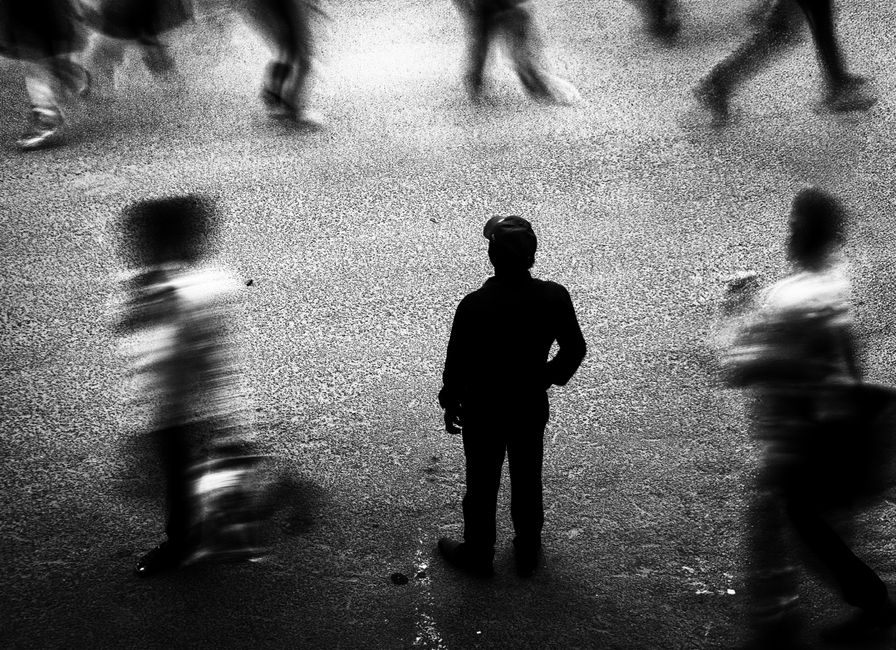
A glassblower works close to a flame that can cut through skin in less than a second, and the first thing they learn is not how to shape glass but how to keep their hands from shaking. The molten material punishes any tremor. Stillness becomes the precondition for everything else. Some people grow up in households that run on a similar logic, where another person’s mood is the open flame and the only safe posture is one that doesn’t disturb the air.
These are often the people who end up being described, later in life, as unusually calm.
You can spot them in conference rooms when something goes sideways. The deadline collapses, a colleague raises their voice, a client sends the email nobody wanted to receive — and there is one person whose shoulders don’t move. Their voice stays the same volume. They ask a clarifying question.
The room reads this as steadiness. Sometimes it is. Sometimes it is the muscle memory of a child who learned, very early, that loud feelings in the room were not a signal to express your own.
What looks like temperament is often training
Developmental research has been quietly complicating the idea that calm is something a person simply has. A 2025 study from Dr. Tahli Frenkel at Reichman University, published in Developmental Psychology, followed mother-infant pairs through the baby’s first year. Some babies are born with what researchers call a turbulent temperament — high sensitivity to new stimuli, a tendency to cry intensely, difficulty calming down.
What the study found is that those babies’ brains looked very different at twelve months depending on what kind of caregiving they received. Sensitive, contingent responses from a parent shaped neural patterns associated with emotional regulation. Inconsistent or mismatched responses produced the opposite — brain activity linked to fear, withdrawal, and difficulty self-soothing.
The child’s nervous system, in other words, gets wired around the adult’s. Not metaphorically. Physically.
Now picture the inverse situation later in childhood: a parent whose moods are not turbulent in infancy but in adulthood. Anger that arrives without a clear trigger. Anxiety that gets projected outward as criticism. A house where the temperature in the room depends on whether someone got a promotion or a parking ticket that morning.
A child living inside that climate develops something the brain is exquisitely good at developing — a tracking system.
Hypervigilance, repackaged as poise
Therapist Robert Taibbi describes this pattern with unusual clarity in Psychology Today. Children raised with emotionally volatile parents, he writes, often become hypervigilant — “always on guard, always looking around corners.” Some respond to that vigilance by becoming volatile themselves. Others, particularly those with quieter temperaments, “duck and cover, retreating to your room, walking on eggshells, being good, and holding back your emotions because you sense it’s never safe enough to show them.”
That second group is the one this article is about. They are the children who learned that crying made things worse, that asking for comfort risked drawing attention, that the safest thing to do when a parent’s voice changed pitch was to make themselves into a piece of furniture. They got very good at reading micro-expressions. They got very good at predicting which version of the adult was about to walk through the door. And then they grew up, and everyone started telling them how calm they were.
The calmness is real. It is also, frequently, the polished surface of something that was once a survival strategy. Taibbi’s point is that the coping skills a child develops do not switch off when the child leaves home. The hypervigilance keeps running in the background, scanning faces in meetings, tracking the energy of partners, registering small shifts in tone that other people miss entirely.
Outwardly: composure. Inwardly: a control room with every monitor lit.
This is part of why so many people who grew up in unpredictable households end up in caregiving professions, in positions of emotional management, in roles where reading other people’s states is the actual job. They were unpaid interns in that work from the age of four.
The body keeps a separate ledger
The cost of all this scanning is rarely visible in the moment. It shows up later, in the body, in patterns that the Adverse Childhood Experiences research has documented for decades. Chronic stress in childhood — including the kind produced by living with a parent who has untreated mental illness, substance issues, or simply a volatile temperament — alters the body’s stress response. The system that should switch on for emergencies and switch off when they pass starts to run continuously.
Higher ACE scores have been linked to increased risk of depression and problematic alcohol use in adulthood. The biology is not subtle, though protective relationships and resilience can make a significant difference.
The calm adult in the conference room may have a resting heart rate that tells a different story than their face does.
Why their stillness reads as strength
There is something genuinely valuable about the skill, even when its origins are painful. People who grew up tracking another person’s mood tend to become, in adulthood, the ones who can sit with a friend in crisis without trying to fix it. They can hear bad news without flinching. They can be in a room with a furious colleague and not absorb the fury.
That last capacity is rarer than it sounds. Most people, faced with someone else’s anger, either mirror it or collapse under it. The person who can stay regulated — who can keep their own nervous system online while someone else’s is offline — is doing something most adults cannot do on demand. They learned it the hard way. They learned it because the alternative, as children, was unbearable.
Carl Weems, a professor of human development and family studies at Iowa State, has argued in a 2025 paper published in Clinical Child and Family Psychology Review, and summarised by his university, that the way adults remember childhood adversity is not a fixed transcript. It evolves. People reimagine events as less traumatic over time, or as more so, depending on intervening experiences and on what their current life is asking them to understand.
This matters for the calm adult because they often describe their childhoods in language that minimises the climate they grew up in. It wasn’t that bad. They were just stressed. Everyone’s parents yelled. The reframe can be protective in the short term and limiting in the long term, because it tends to obscure the connection between the household they came from and the nervous system they live in now.
Recognising the connection is not the same as blaming anyone. It is closer to reading the manual for a machine you have been operating intuitively for forty years.
Where the pattern frays
The composure has limits, and the limits tend to appear in specific places. One is in intimate relationships, where the same hypervigilance that makes someone an excellent manager can make them an exhausting partner — always one step ahead of moods that haven’t arrived yet, managing situations that aren’t actually unfolding, reading micro-expressions that mean nothing. Partners often describe feeling watched in ways they cannot quite name.
Another is in moments of their own genuine need. People who learned that their feelings destabilised the room often cannot identify what they feel, let alone ask for support. They can hold a friend through a divorce and not mention that they themselves have been crying in the car. The stillness, which was protective in childhood, becomes a kind of isolation in adulthood.
And the third is the body. The stomach problems, the jaw tension, the sleep that doesn’t quite restore. The system has been on duty for a long time.
Taibbi’s clinical point, and the point that developmental psychologists who study emotion regulation tend to converge on, is that adult emotional regulation is learnable. It is not a fixed trait. The skill of slowing down enough to notice what you are feeling, naming it, and choosing a response rather than executing a reflex — that can be built at any age.
For the calm adult, the work is often counter-intuitive. It is not learning to be more composed. They have that part. It is learning that composure is allowed to be a choice rather than a requirement. That the room will not catch fire if they raise their voice. That their feelings, expressed at normal volume, are not a threat to anyone’s safety. Some of them spend years in therapy slowly relocating the dial from always off to sometimes on.
Not everyone calm is carrying this
The pattern is common enough to be worth naming, but it isn’t universal. Some people are calm because their temperament was steady from the start and their childhood was steady around it. Some people meditate. Some people simply do not feel things very intensely. The reframe being offered here applies to a specific subset — the ones whose stillness has a watchful quality, whose calm tightens slightly when voices rise, who can describe in granular detail what every person in a room is feeling but stall when asked about themselves. If none of that lands, the calm probably is just calm.
But for the ones it does describe, there is a moment, often, that gives the pattern away. It is when someone thanks them for being so steady during something hard, and they smile and accept the compliment, and then later, alone, they feel a flicker of something they cannot quite name. Not pride. Something closer to grief.
Because the steadiness was real, and it helped, and it was also built by a child who did not get to be anything else.
That child is still in there, somewhere behind the composure, still scanning the room, still keeping the hands from shaking near the flame. The adult version has more options now. Most of them just take a long time to remember that.