
Resource Hubs: For more long-form features on natural wonders, hidden places, and the science of human attention, browse the Growth List features library.
A cathedral has a front door. Hyperion does not.
The tallest known living tree on Earth stands somewhere in Redwood National Park, and the National Park Service will not tell visitors where to find it. The grove around it is closed, and anyone caught entering can face up to six months in jail and a $5,000 fine.
Hyperion is a coast redwood, Sequoia sempervirens, discovered by Chris Atkins and Michael Taylor on August 25, 2006. Guinness World Records lists the tree at 116.07 metres, or just over 380 feet, based on a 2019 measurement, while the original 2006 tape-drop measurement was 115.55 metres, or 379 feet 1.2 inches.
That is taller than the Statue of Liberty from heel to torch with a school bus stacked on top.
The tree was climbed and measured shortly after its discovery, because a laser estimate was not enough for a world-record claim. In a forest of giants, the final proof still came down to a person in the crown and a tape lowered through the branches.
The closed grove in Redwood National Park
The National Park Service says Hyperion is in a closed area of Redwood National and State Parks. The agency’s public guidance is not subtle: “Should I hike to Hyperion?” is answered with a legal closure and a warning, not a map.
The closure includes Tom McDonald Creek and the surrounding area upstream from its confluence with Redwood Creek. It exists to protect park resources, not to create mystique around a celebrity tree.
There is no official trail to Hyperion. Visitors who tried to reach it bushwhacked through steep, creek-cut terrain, creating informal paths through the understory and wearing down the forest floor around the tree’s base.
This is not harmless foot traffic. Coast redwoods have shallow, spreading root systems rather than deep taproots, and the living skin of the forest floor matters to a tree that stands more than 35 storeys high.
Why the Park Service stopped the pilgrimages
In 2022, the Park Service made public access to Hyperion’s area illegal. The agency warned that people entering the closure could face a maximum $5,000 fine and up to six months in jail.
The announcement followed years of people trying to reconstruct the tree’s location from online clues, old trip reports, and photographs. The Park Service said the area around Hyperion had been damaged by visitors who trampled vegetation and created a web of social trails.
Reports from the closure period described human waste, discarded toilet paper, and damage around the base of the tree. One of the strangest parts of the story is that many people who found Hyperion were disappointed when they arrived.
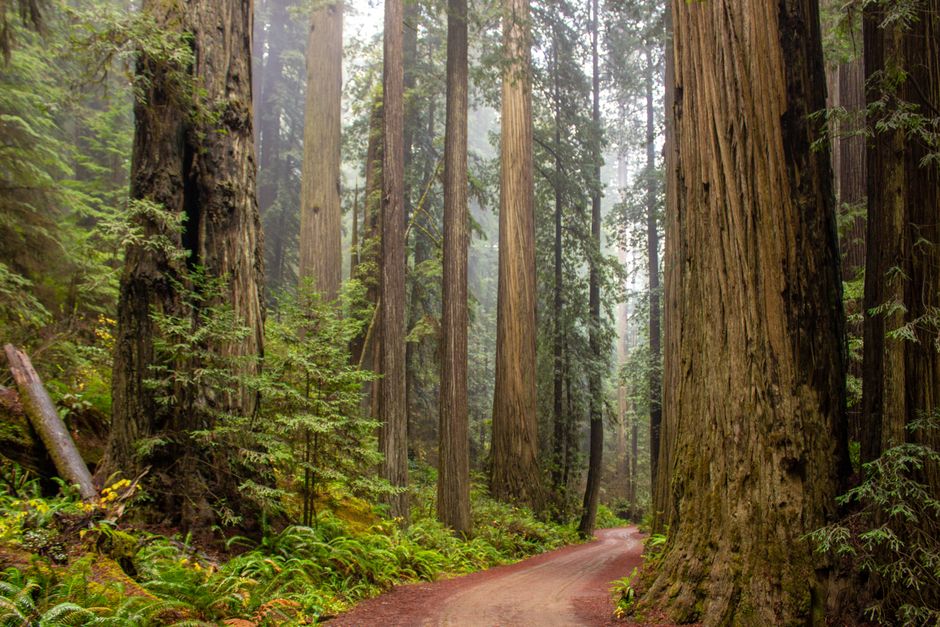
From the ground, the world’s tallest tree does not look like a trophy. Coast redwoods grow in dense stands, and from the base of a 380-foot tree, the crown is mostly hidden by trunk, branch, fog, and neighboring trees.
The pilgrims were arriving for a number, not a view.
The math of a 380-foot tree
A coast redwood pulls water from soil to crown against gravity through xylem, aided by evaporation from leaves high in the canopy. The taller the tree becomes, the harder that water column is to maintain.
In a 2004 Nature study on the limits to tree height, George W. Koch, Stephen C. Sillett, Gregory M. Jennings, and Stephen D. Davis estimated that coast redwoods under current conditions top out around 122 to 130 metres, barring mechanical damage.
Hyperion is not at that ceiling, but it is close enough to make the physics visible. A tree a little over 116 metres tall is already living in the narrow upper range of what water transport, leaf stress, gravity, and wood structure allow.
The top of a very tall redwood is a different world from the lower crown. Studies of Sequoia sempervirens foliage show that redwoods can absorb water directly through leaves, and that shoots in the upper crown are shaped by the need to manage water stress in a foggy but seasonally dry coastal climate.
That is why the redwood canopy is not just decoration. It is plumbing, storage, weather, and survival at once.
The tree does not need to be visited to be real
The National Park Service is asking people to want a thing and not pursue it. That is the emotional tension at the centre of Hyperion’s modern life.
Dacher Keltner, a psychologist at the University of California, Berkeley, has spent decades studying awe. In research summarized by National Geographic, awe is described as a state that can shift attention away from the self and toward something larger.
That does not mean Hyperion itself is necessary. A 2015 study in Emotion found that awe was the strongest positive-emotion predictor of lower levels of pro-inflammatory cytokines in the sample studied, after controlling for health and personality factors.
Brain-imaging research has pointed in the same direction. A 2019 study on the neural correlates of awe found reduced activity in parts of the default mode network during awe videos compared with other viewing conditions.
The experience people are chasing at Hyperion is not locked inside one forbidden drainage. It is available in the scale, silence, and vertical shock of the redwood forest itself.
The groves people can actually walk in
Redwood National and State Parks still contain groves where visitors can legally stand among old-growth redwoods. Tall Trees Trailhead requires a day-use reservation, but it leads into one of the park’s most famous redwood landscapes.
Stout Memorial Grove in Jedediah Smith Redwoods State Park is a short half-mile loop near the Smith River. It does not need a hidden coordinate to make the body look up.
Founders Grove in Humboldt Redwoods State Park offers another kind of encounter: a named, accessible grove tied to the early preservation history of the redwoods and the Avenue of the Giants.
None of these trees are Hyperion. All of them can still produce the same human reaction: the small, involuntary recalibration that happens when the eye runs up a trunk and cannot finish the climb.
Standing under a 350-foot redwood and standing under a 380-foot redwood are not meaningfully different experiences for most human bodies. Both saturate the upward field of view. Both compress time.
The closed place in the fog
The useful image is not a secret file or a treasure map. It is a closed slope in a national park, a living root zone recovering from attention, and a tree whose fame became one more stress on the ground around it.
Hyperion is still growing slowly in a place the Park Service will not name. Fog rolls in from the Pacific, gathers on needles high in the crown, and falls back through the branches toward the duff below.
The tree does not need a crowd to complete the fact. It is already doing the improbable work: holding water, wood, light, gravity, and 600 or more years of weather in a single column of red bark, somewhere beyond the trail.