
🗺 Part of the Growth List Startup Lists Collection All Startup Lists | By Funding Stage | Sales Outreach | Startup Intelligence
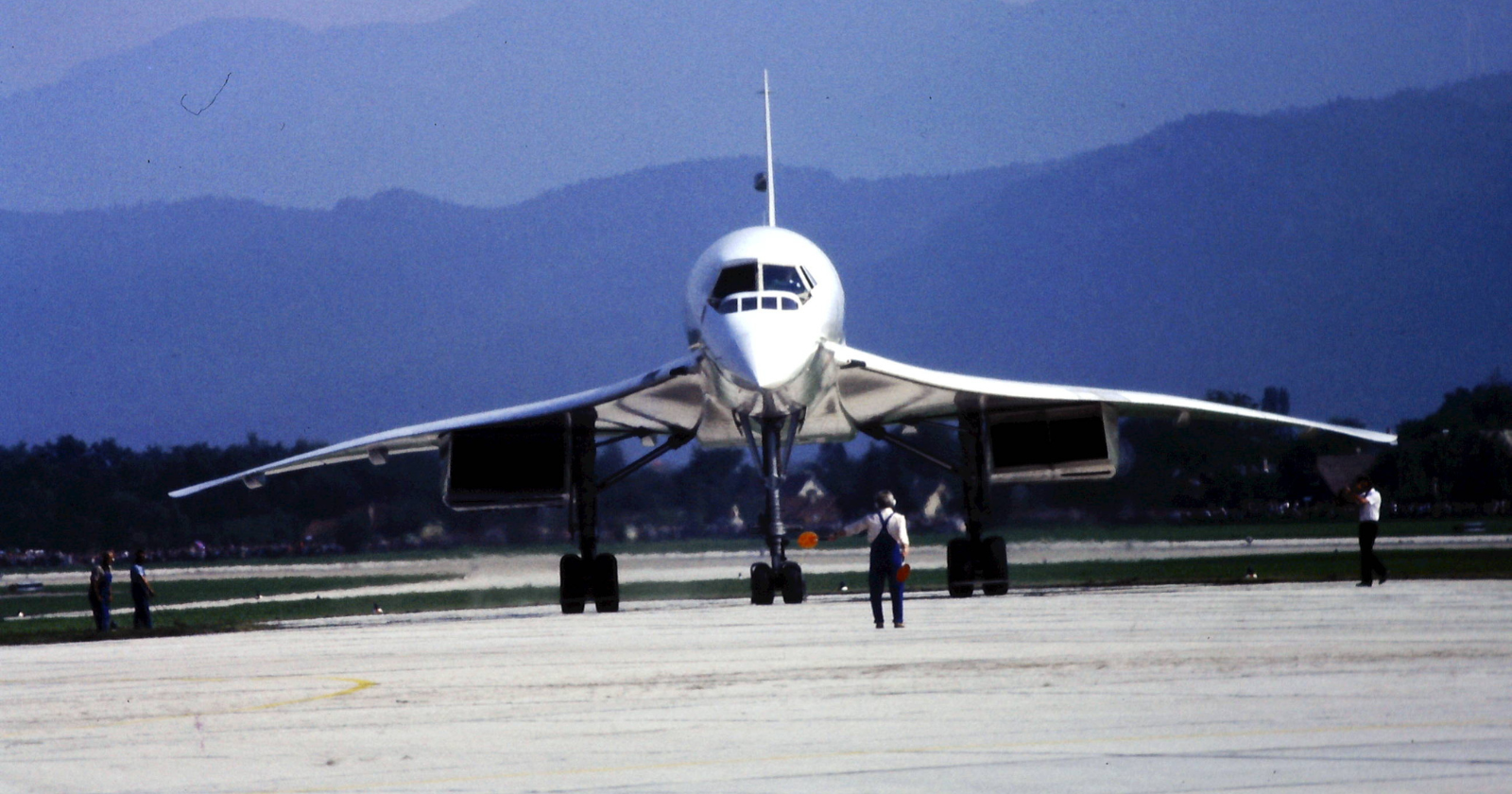
At Mach 2 the nose of Concorde was a needle, a long tapered fairing built to slip through a supersonic shockwave with as little drag as possible. On final approach into Heathrow that same needle hung downward at twelve and a half degrees, the entire forward fuselage swung toward the ground on hydraulic jacks, because with the nose left straight the pilots could see roughly five degrees of the world ahead and none of the runway they were about to touch.
The drooping nose is usually remembered as a flourish, a piece of Anglo-French theatre that made the aircraft look like a bird of prey on approach. It was nothing of the kind. It was the bill that came due for the wing.
Why the nose had to move at all
Concorde cruised at about 1,350 mph, a little over twice the speed of sound, according to Tech Digest’s 50th-anniversary breakdown. To make Mach 2.04 viable the airframe used an ogival delta wing, a sharply swept shape that generates lift from vortices spilling off its leading edges rather than from the pressure differential a conventional airliner wing relies on.
Delta wings are superb at high speed and clumsy at low speed. They have no flaps, so to make enough lift to land they must fly at a steep angle of attack, which is why every delta-winged aircraft, from the Mirage III to the Space Shuttle, comes down with its nose pitched markedly upward. On Concorde that meant roughly thirteen to eighteen degrees of pitch on approach, an attitude that turned the long pointed nose into a wall directly in front of the cockpit.
A fixed streamlined nose, the engineers calculated, would have left the crew about five degrees of forward vision during landing — useless for the most demanding ninety seconds of any flight. They considered periscopes and downward-canted windows. The answer that shipped was mechanical: hinge the forward fuselage, including the windscreen visor, to the forward pressure bulkhead and rotate it down for taxi, takeoff, and landing.
The mechanism had two settings, five degrees for taxi and takeoff and twelve and a half degrees for approach and landing, and it was designed and built under subcontract by Marshall Aerospace at Cambridge, on behalf of the British Aircraft Corporation. Construction of the first prototypes began in February 1965; the system flew when Concorde 001 lifted off from Toulouse under André Turcat on 2 March 1969, and again when Brian Trubshaw took 002 up from Filton that April, as the Smithsonian National Air and Space Museum records.
The view from the flight deck
The droop carried a retractable visor across the windscreen. On the two prototypes that visor was a two-piece metal shroud with small windows and a periscope, because the glass technology of the era could not yet produce a transparent panel able to survive the heat and aerodynamic load of Mach 2 flight. The production aircraft replaced it with a single glazed visor, much to the relief of the crews, as the Heritage Concorde archive documents.
The nose itself was driven by a pair of tandem hydraulic jacks working in parallel, their upper cylinders anchored to the pressure bulkhead and their lower cylinders to the nose structure, with up-locks to hold it in place once raised so hydraulic pressure could be released in cruise. Two jacks meant two load paths, redundancy for a part that swung in the airstream.
All of it — the jacks, the visor rails, the added weight in the most forward part of the airframe, the dedicated inspection cycles, the extra failure mode — existed for the four to six minutes per flight when the pilots needed to see a runway. The aircraft spent the bulk of a seven-hour Atlantic crossing at cruise, nose up and aerodynamically clean. The hardware was sized for the worst few minutes, not the routine hours.
The visibility problem outlived the airplane
Concorde solved the geometry of seeing the runway. It did not solve the problem of seeing, which still drives a share of commercial aviation accidents, now through weather and disorientation rather than airframe shape.
The NTSB’s investigation into the 26 January 2020 crash near Calabasas that killed Kobe Bryant, his daughter Gianna, and seven others concluded that pilot Ara Zobayan suffered spatial disorientation after flying a Sikorsky S-76B into a marine layer, according to NBC News reporting on the hearing.
NTSB Chairman Robert Sumwalt described spatial disorientation as “the powerful, misleading sensations that can confuse a pilot conducting a visual flight who loses visual references.” Zobayan was experienced, with about 8,500 hours and roughly a decade flying that corridor. The loss of visual reference killed him anyway.
Sumwalt argued during the hearing that a second pilot would likely have caught the descent. “I flew with two pilots for a long time and in an airline environment, you get the redundancy that if one pilot is struggling, the other pilot would be able to sit back and say, ‘Wait a minute, you are banking 30 degrees to the left and starting a descent.’”
The aircraft now being designed to bring supersonic travel back are answering the same five-degree problem Concorde answered with hydraulics, but with photons instead of hinges: Boom Supersonic’s Overture plans to keep a fixed nose and feed nose-mounted camera arrays into a synthetic-vision display, letting the crew look through solid structure on a high-angle approach. The window moves to a screen. The problem does not move at all.
Heat, stretch, and the fatigue that follows
The other thing Concorde could not engineer away was what happened to the metal at speed. At Mach 2 skin friction heated the fuselage to roughly 127°C and the airframe physically stretched between six and ten inches in flight. The engineers did not fight the expansion. They measured it, instrumented it, and built tolerance for it into every joint, fastener, and panel the heat could reach, across thousands of cycles.
Modern airframes inherit the same fatigue problem in cooler regimes, and the failures look almost identical when the discipline lapses. The NTSB’s final report on Delta Flight 1092, which landed at Charlotte Douglas without nose gear on 28 June 2023, traced the failure to a fatigue fracture in the upper lock link of the nose landing gear, started by surface scratches left during manufacturing, as reported by FOX 5 Atlanta.
Boeing and McDonnell Douglas had issued a service bulletin on that component back in 2001. The facility that overhauled the part did not fully comply with it. The crack propagated quietly for years, through more than forty thousand flights, until the link failed under load. Everyone aboard evacuated without injury, which is the only reason the event reads as an investigation rather than a tragedy.
A nearly identical sequence played out on Frontier Flight 3506, an Airbus A321neo arriving in San Juan from Orlando on 15 April 2025. FlightGlobal reported, citing the NTSB’s preliminary report, that a hard landing tore the left wheel and tire of the nose gear off its axle.
Fragments of that wheel were ingested by the number-one Pratt & Whitney PW1100G turbofan, damaging the inlet cowl liner, the thrust reverser, the fan blades, and the guide vanes. CNN’s coverage noted the aircraft, full of passengers and crew, landed safely on a second attempt with no one hurt.
Concorde built six to ten inches of thermal stretch into its skeleton because it could not be removed, and the tradeoff stayed explicit and respected for twenty-seven years of service. The cracks creeping out of a manufacturing scratch, the inspection deferred past its bulletin, are not tradeoffs anyone chose. They are tradeoffs that were made once, written down, and then forgotten somewhere downstream.
The fleet is gone now. Concorde’s last commercial flight landed at Heathrow on 24 October 2003, two decades after G-BOAD crossed from New York to London in 2 hours, 52 minutes, and 59 seconds, a transatlantic record that still stands. The aircraft sit in museums on three continents, engines cold.
And on most of them the nose still hangs down at its landing angle, twelve and a half degrees toward a runway that is no longer there — the one position the designers built for the few minutes that mattered most, frozen now for the years that no longer do.