
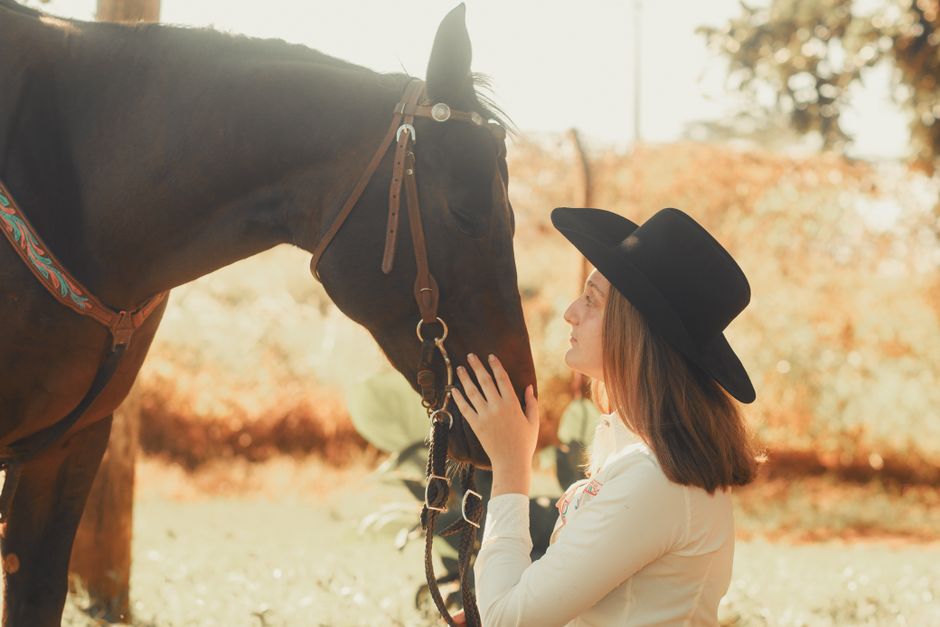
The barn smells like warm hay and old leather, and the woman standing in the aisle has not moved for almost a full minute. Her hand is out, palm down, at about the height of the mare’s nose. She is not looking at the horse. She is looking at a knot in the wood of the stall door, breathing slowly, waiting for the animal to close the last few inches on her own.
To a passerby, this looks like reverence. Or shyness. Or some soft, aesthetic idea of what a “horse person” is supposed to be. It is none of those things. It is a skill.
People who move this way around animals — the ones who whisper instead of announce, who crouch beside a nervous dog rather than looming, who wait for the cat to make the last decision — are not performing tenderness for an audience. They have learned, often through many small failures, that a certain kind of trust only shows up in the version of a person who is not in a hurry.
And what they have learned about animals turns out to be almost identical to what long-term research keeps finding about people.
The gentleness is a strategy, not a personality
Watch someone experienced greet an unfamiliar dog. They will usually turn their body slightly sideways, drop their eyes, let their hand hang loose, and say almost nothing. They are not being coy. They are removing every signal a prey-attuned nervous system reads as threat: frontal approach, direct stare, sudden vocalization, reaching from above. Eye-tracking work by Sanni Somppi and colleagues at the University of Helsinki, published in PLOS ONE, found that dogs avert their gaze from threatening human faces within the earliest fixations — a response the authors link to appeasement rather than fear alone.
The American Veterinary Medical Association treats this as clinical territory rather than sentiment. Its standing policy on the human-animal bond defines the relationship as mutually beneficial and dynamic, shaped by behaviors that bear directly on the health of both parties, and assigns the veterinarian a role in minimizing negative interactions and promoting positive ones. The bond is built in exactly these micro-moments: the choice to slow down, to let the animal set the pace.
None of this requires loving animals in some cinematic way. It requires noticing that the creature in front of you has a nervous system, and that its nervous system is reading yours in real time.
Why hurry is the thing that breaks it
Hurry is not a moral failing. It is a physiological state. A person moving quickly is breathing shallowly, holding tension in the shoulders, scanning the environment for the next task. Every one of those signals is visible to a horse or a dog long before any word gets spoken.
Horses are unusually good readers of human affect, though not in the way barn folklore tends to describe it. They are not sensing your pulse from across the aisle. They are reading posture, movement, facial expression and voice — and the response is measurable. A 2025 study in Scientific Reports exposed 45 horses to video of humans displaying fear, joy, or nothing in particular, and recorded higher heart rates and increased ear movement during both emotional conditions, with a sharper rise in eye temperature during fear. Separate work using wearable monitors found that horses’ heart rate variability shifts toward a more relaxed profile when they are handled by a familiar person rather than a stranger performing the identical task.
That last detail is the one that matters. The task was the same. The animal’s nervous system was not responding to the task. The people who get trusted quickly have usually figured out something quietly inconvenient: they cannot fake the internal state. They have to actually be in it.
What the horse people know about the human ones
The interpretive move a nervous horse is making — reading a stranger’s body for whether this is a safe encounter or a hurried one — is close to the move a human partner makes across a kitchen at the end of a long day.
The psychologist Robert Weiss introduced the term sentiment override in 1980; John Gottman later built it into decades of couples research and gave the favorable version its familiar name, positive sentiment override. It describes an accumulated reservoir of goodwill deep enough that a partner’s ambiguous behavior gets read charitably without anyone deciding to be charitable. Negative sentiment override is the inverted condition, where even neutral or well-meant behavior lands as further proof of disregard. Clinicians have since built assessment instruments around the construct, one of which was tested on couples-counseling clients by Olson, Chesnut and DeCino in the Journal of Mental Health Counseling.
A canceled plan, under one climate, is absorbed as a scheduling problem. Under the other, the same canceled plan confirms something long suspected. The behavior did not change. The lens did.
Trust itself is a standing conclusion. It forms slowly, stabilizes, and resists revision. But almost nothing that happens between two people on a Tuesday evening is large enough to touch that conclusion. It is small — a curt reply, a distracted greeting, a forgotten errand — and it has to be interpreted anyway.
How partners explain that kind of ambiguous behavior turns out to track closely with how satisfied they are. Kelsey Sullivan, Ryan Sullivan and Thomas Bradbury, validating an attribution measure in Family Relations, found the explanation doing more work than the incident. Which is what the horse people already knew. The animal is not deciding, in that first minute, whether the human is a good person. It is deciding what lens to use for everything that comes next.
The reservoir is not a fixed trait. It accumulates through the running ratio of warm to cold exchanges, and the two do not weigh the same. A longitudinal analysis by Matthew Johnson and colleagues in Personality and Social Psychology Bulletin, following couples over time, found that negative exchanges tracked shifts in relationship satisfaction more reliably than positive ones did. The person kneeling beside the anxious dog knows the asymmetry instinctively. Every unhurried greeting is a deposit. Every rushed grab for the collar is a larger withdrawal.
Why letting the cat come to you is a whole philosophy
Cats are the clearest teachers of this because they refuse to reward shortcuts. Dennis Turner, reviewing decades of work on the mechanics of cat-human social interaction, reports a consistent finding: who initiates an encounter predicts how long it lasts. Interactions the cat starts run longer than interactions the human starts.
The reach-first person is having a different encounter than the wait-first person, even if both eventually get to pet the cat. A study of human handling styles in Scientific Reports found the same axis running underneath: handling patterns that gave cats less choice and control over the duration and location of contact — initiating and breaking contact repeatedly, touching less-preferred areas — were the ones associated with lower feline comfort.
Choice and control. Not affection, not intent, not how much the person likes cats. The animal that closed the last two inches on its own is a different collaborator than the animal that was grabbed and tolerated it.
This is the piece that transfers most cleanly. A partner who feels approached, rather than reached at, comes into the room as a different person. The lens they use on the rest of the evening has already been set by whether the greeting felt like an invitation or a requirement.
The counter-case
It is worth being honest about where this stops applying. A generous lens is the right tool for behavior that is actually ambiguous — the unanswered text, the distracted hello, the plan that collapses without explanation. It is not a method for absorbing a pattern that has already declared itself.
A deep reservoir of goodwill has a failure mode of its own. The same default that keeps small frictions small can blunt the signal when something genuinely warrants alarm, because the lens was built to resolve ambiguity in one direction and keeps doing so after the ambiguity is gone. Generosity belongs to what is unclear. It does not belong to what has already been made plain.
The same holds with animals. A person who has been bitten repeatedly by the same dog is not being enlightened when they keep offering a soft hand. They are discarding information the animal already gave them.
Slowness is a discipline. It is not a suspension of judgment.
Back in the aisle
The mare closes the last few inches. Her nose touches the woman’s palm — not a nuzzle, just a check — and then withdraws by an inch, thinking about it. The woman does not move. She lets the horse have the second inspection too.
Whatever is being settled in that half-second has almost nothing to do with the woman’s résumé as a horse person and almost everything to do with what her shoulders and her breathing were doing in the sixty seconds before the horse arrived.
It is close to the decision a partner makes, silently, when the door opens at the end of a Tuesday. Nobody announces it. Nobody could tell you afterward when it happened.
The hay smell, the knot in the stall door, the hand held still at nose height a beat longer than feels comfortable. The people who have learned this in barns and living rooms tend to be, without advertising it, unusually easy to be around. They are not gentler than everyone else. They are just less in a hurry to be trusted.