
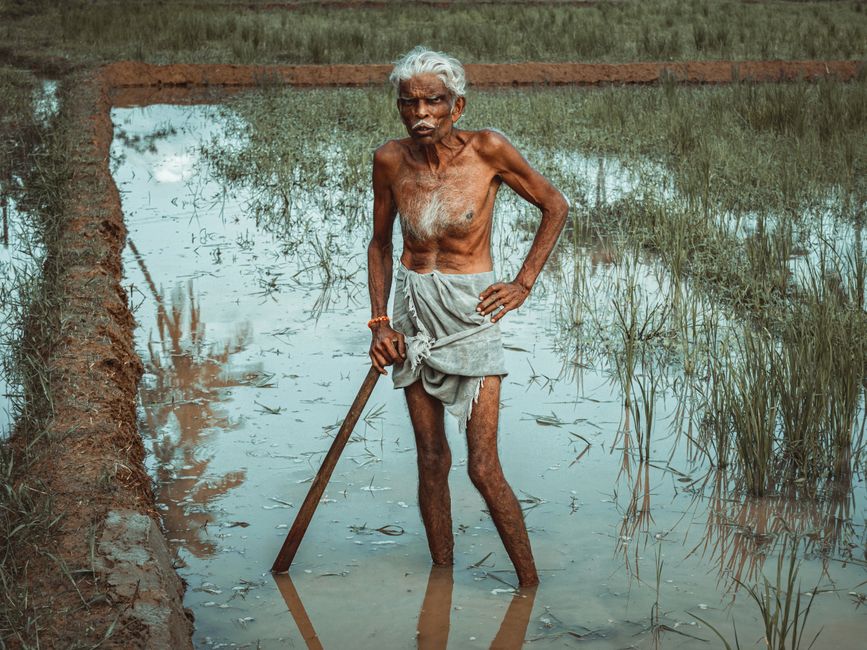
There is a particular kind of “no” that developers hear from farmers in their seventies and eighties, and it confuses everyone in the room. The offer is generous. The math, on paper, is unarguable. The farmer says no anyway, and cannot fully explain why.
The easy reading is stubbornness. Sentimentality. A refusal to adapt.
The more accurate reading is that this person has spent sixty years accumulating something they were never asked to put into words, and they have watched, up close, what happens to the neighbours who did take the money.
The knowledge that never made it onto a spreadsheet
The philosopher Michael Polanyi described tacit knowledge — the enormous body of understanding a person carries that they cannot fully articulate. A farmer knows which corner of the north field holds water three days longer after a storm. They know the sound a tractor makes the week before something goes wrong. They know which fence line the deer cross in October and why the pear tree by the barn survived the hard freeze when the others did not.
None of that is in the deed. None of it transfers with the title.
Ikujiro Nonaka, writing in Organization Science in 1994, built an entire theory of how organizations create value on this idea — that the knowledge which actually runs a place is mostly the kind that lives in the body of the person doing the work. It is learned by doing, over years, and it degrades the moment that person leaves.
Older farmers know this intuitively, because they have watched it happen.
The pattern they describe is quiet and it repeats. A neighbour sells. The check clears. For eighteen months, everything looks like a good decision. Then something starts to unravel that no one predicted.
Sometimes it is the marriage. Sometimes it is the drinking. Sometimes it is a son who cannot find a shape for his week without the four a.m. alarm and the animals waiting. Sometimes it is the wife, who thought she wanted the condo and discovered, in a way she could not have known in advance, that the garden had been holding something together in her that the balcony could not.
David DeLong made the organizational version of this argument in Lost Knowledge, his 2004 study of what departs with an ageing workforce: companies lose capacities they never knew they had, because nobody ever had to write them down. A life works the same way. A person can be doing something for themselves for fifty years without ever naming what it is, and selling the setting reveals the function only in its absence. The organizational literature even has a term for why the value will not travel — Gabriel Szulanski’s “internal stickiness”, his account of why best practices are so hard to move from one site to another. Borrow it and the farm case reads clearly enough. The value is bound up in the context. You cannot lift it out clean.
The land as an unnamed structure
Ask a farmer in his late seventies what the farm gives him and you will often get a shrug, or a joke about the mortgage, or a list of complaints about the price of diesel. What you will not get, usually, is the real answer, because the real answer has never had to be spoken aloud.
The land is a schedule. It is a reason to be upright by six. It is a body of physical work that keeps the shoulders and hips moving in ways a gym never quite replicates. It is a set of relationships — with the co-op, the vet, the neighbour who plows the drive when the tractor breaks, the grandson who comes on Saturdays. It is a rolling calendar of small competences that confirm, every week, that the person is still capable of things.
Etienne Wenger’s work on communities of practice made this point about workplaces: identity and skill are inseparable from the setting in which they were built. You take a person out of the practice and you do not just take away their job. You take away a large part of the scaffolding they were using to be themselves.
The farmer who says no is often, without knowing it, refusing to dismantle that scaffolding for a lump sum.
The developer’s offer, by contrast, is legible. It has a number on it, and the number is larger than most numbers the farmer has seen in one place in his life. What it cannot price is everything the tacit side encompasses. It prices acres. It does not price the fact that he sleeps better on this land than he does anywhere else, or that his wife can find everything in a kitchen she has used since 1974, or that the seasonal rhythm has been organising his days for forty years without anyone calling it that.
Thomas Davenport and Laurence Prusak, in their book Working Knowledge, argued that the most valuable knowledge in any organization is the hardest to see, because it is embedded in routines that no one has ever had to justify. Farms are the same. The value is in the routines. The routines are invisible until they are gone.
The forecast on the wall
There is a reason the Old Farmer’s Almanac has been on kitchen walls for generations. It has not missed a year since 1792, which makes it the oldest continuously published periodical in North America, and it still leans on a secret forecasting formula its first editor claimed was about eighty percent accurate. Farmers do not keep it because they believe every prediction. They know forecasts are imperfect. They keep it anyway.
They keep it because a person who lives close to weather learns to hold forecasts loosely. A mild winter is predicted; the mid-December cold snap arrives anyway. An Arctic blast is called for late January; it shows up in the first week instead. The almanac is not a promise. It is a way of paying attention.
The same instinct governs the response to the developer. The offer is a forecast. It predicts a better life on the other side of the sale. The farmer has watched enough forecasts miss by three weeks and one degree to know that a prediction is not a fact, and that the cost of being wrong about this particular one is not recoverable.
What the research on late-life transitions actually shows
The population evidence is more complicated than the folk version, and it is worth being honest about which way it cuts. Giansanto Mosconi and colleagues at the University of Pavia tracked 8,998 people across 27 European countries and Israel in the Survey of Health, Ageing and Retirement in Europe and found that the risk of depression fell after retirement — about eleven percent lower in the following year. The reversal came later. From the tenth year onward, depressive symptoms rose significantly among late retirees and former non-manual workers, and the risk of suicidality climbed from roughly five years out.
Cognition tells a similar two-part story. Susann Rohwedder and Robert Willis, comparing survey data from the United States, England and eleven European countries, found that early retirement had a measurable and causal negative effect on the memory scores of people in their early sixties. A later systematic review in BMC Geriatrics muddied it usefully: whether retirement looks harmful depends a great deal on which abilities are being measured.
The farm-specific literature is narrower and points more directly. Chloe Fletcher, Louise Stewart and Kate Gunn at the University of South Australia reviewed the research on Australian farmers approaching retirement and found that the stressors and the barriers were largely the same list — declining physical capacity, pressure to live up to farming ideals, financial worry, and retirement experienced as a threat to identity. What helped was not a bigger cheque. It was a gradual transition, a strong social network, interests beyond the farm, and succession planning begun early.
Read that way, the farmer who says no is not refusing money in the abstract. He is refusing the version of the trade the evidence treats least kindly: abrupt, total, unplanned, a structuring practice swapped in one afternoon for an unstructured surplus.
The neighbour who took the offer and then, two winters later, could not seem to get out of the recliner — that neighbour is the data point. The farmer does not need a longitudinal study. He has one running down the road.
Where the reframe does not apply
Not every refusal is wisdom. Some farmers hold on past the point where holding on is serving them, and their children spend a decade watching a person become trapped by a place that has stopped giving back what it used to. Some refusals are fear dressed up as principle. Some are a way of avoiding a conversation about what comes next that should have happened a decade earlier.
The research does not even show that attachment and refusal travel together. When Mark Burbach, Stephanie Kennedy and Shari Kunert surveyed Nebraska and Kansas farmers aged fifty-five and over, the ones who had a succession plan in place scored higher on place identity, place dependence and overall attachment than the ones who did not. Loving the ground is not what stops people planning for the day they leave it.
The reframe is not that every “no” is right. It is that the “no” is almost never about stubbornness, and treating it that way — as a problem to be solved with a higher number or a firmer adult child — misreads what is being protected.
What is actually being said
When an older farmer refuses a life-changing offer, the sentence underneath the sentence is usually something like this: I have spent sixty years learning how to be a person in this exact place, and I do not know how to be a person somewhere else, and I have watched what happens to people who found out too late that they didn’t either. That is not stubbornness. That is a lifetime of tacit knowledge doing what tacit knowledge does — protecting the holder from a loss they can feel but cannot fully name.
The developer will come back next spring with a better number. The farmer will be out at first light, checking the fence line the deer cross in October, listening for the sound the tractor makes the week before something goes wrong, and the answer will be the same one it was this year, for reasons that will still, mostly, go unspoken.