
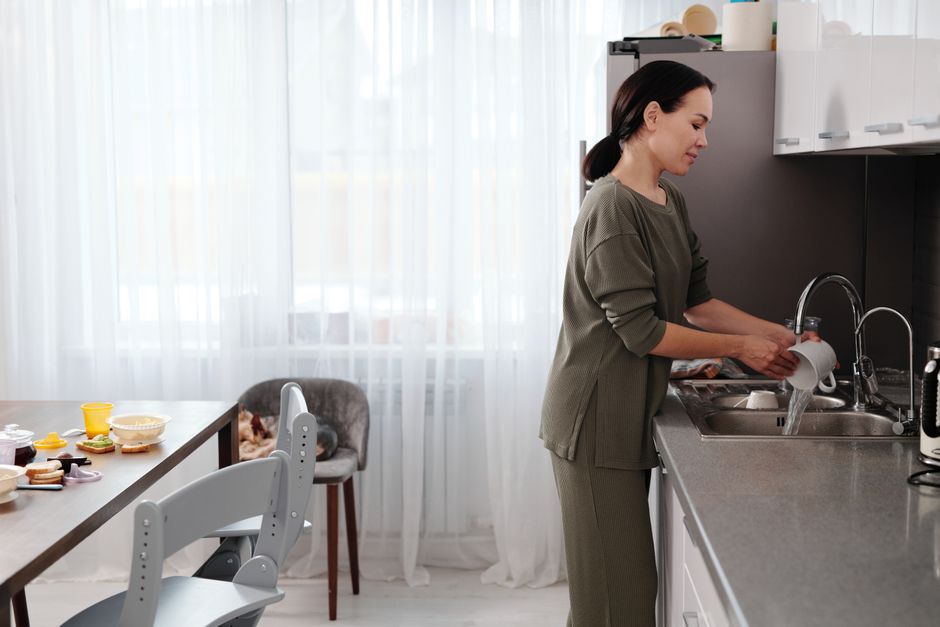
The guest stands up before the plates are cold. They clear, they run the tap, they wave off every offer of help with a cheerful insistence that brooks no argument. The host protests. The guest keeps scrubbing. Everyone laughs about it. And nobody quite names what is actually happening at the sink.
It reads as good manners — breeding, gratitude, the reflex of someone raised to earn their keep. Sometimes it is exactly that. But there is a version of this behavior with a slightly urgent edge, one that will not take no for an answer, and it is doing a different job entirely.
What is happening, often, is regulation.
The room that never quite feels like yours
Being a guest in someone else’s home is a low-grade cognitive load most people never articulate. The cupboards are in the wrong places. The light switches are somewhere unfamiliar. The dog has opinions. The rhythms of the household — when people sit, when they get up, who talks over whom — follow rules you have to read in real time.
For an adult with a well-regulated nervous system and a secure sense of belonging, this registers as mild novelty and nothing more. For a lot of other adults, it registers as a soft, continuous alert. Not danger. Just the quiet hum of a body that has not been given permission to fully sit down.
The autonomic nervous system moves between the sympathetic branch, which prepares the body for action, and the parasympathetic branch, which predominates in quiet rest-and-digest conditions. In a dysregulated state, the sympathetic side tends to dominate, holding the body at a heightened level of alert even when no real danger is present.
Stephen Porges, who developed polyvagal theory, coined the term neuroception for the way neural circuits sort a situation into safe, dangerous or life-threatening without any conscious appraisal taking place. In his 2004 account of the idea, Porges noted that a child’s or an adult’s nervous system may register threat simply on entering a new environment. The body reads “not mine” and keeps a small light burning.
Why the sink specifically
Of all the things a guest could do to discharge that low hum of alertness, washing dishes is almost uncannily well designed. It is repetitive. It is warm. It involves water on the hands. It has a beginning, a middle and an end. And crucially, it is a task the body already knows by heart.
There is even a small study on exactly this. Adam Hanley and colleagues at Florida State University asked 51 students to wash dishes, half of them after reading a passage directing their attention to the smell of the soap and the warmth of the water. Published in Mindfulness in 2015, the results showed the attentive group reporting a 27 percent drop in nervousness and a 25 percent rise in feeling inspired. The control group, who read about dishwashing technique, showed no change. It is one small sample of undergraduates, not a law of nature. But it points at the same mechanism.
Muscle memory is a kind of shortcut past the thinking brain. The MIT neuroscientist Ann Graybiel, reviewing the basal ganglia circuitry behind habit, describes fully acquired habits as performed almost automatically, virtually nonconsciously, freeing attention to be focused elsewhere. When the hands know exactly what to do, the nervous system gets to stop scanning the room.
The therapeutic version of this principle is well established. The psychiatrist Bruce Perry, whose Neurosequential Model of Therapeutics was developed for maltreated and traumatized children, builds treatment around patterned, repetitive, rhythmic somatosensory activity — walking, drumming, rocking — on the grounds that the lower brain regions governing the stress response settle to rhythm before they settle to conversation. The dish-doer at your kitchen sink is not in treatment. But the ingredients are the same ones.
By the time the last pan is drying on the rack, something has usually shifted. The guest is chattier. Shoulders lower. What happened was twenty minutes of predictable sensory input, warm water on skin, a task with a clear ending, and — importantly — a socially sanctioned reason to be alone in a smaller, quieter room. The parasympathetic branch got its turn. The guest can now be a guest.
The polite cover story
Nobody stands up after dinner and announces they are going to regulate their nervous system using warm water and a sponge. They say things like oh let me, please, I want to, sit down, honestly, it’s the least I can do. The politeness is real. It is also perfectly camouflaged.
The behavior gets read as generous, and it is generous. But the urgency underneath the offer — the way certain guests will physically refuse to let a host near the sink — is not really about hospitality etiquette. It is about the guest needing the task more than the host needs the help.
Ordinary politeness is flexible. A guest offers to help, the host says no, the guest sits down. Everybody is fine. The regulatory version is the one that will not take no for an answer. The guest who keeps standing up. The guest who follows plates into the kitchen. The guest who looks visibly uncomfortable when made to sit while others clean.
That is the tell. Not the offer, but the inability to accept the counter-offer. Being told to sit down and receive care in a room that does not feel like yours is not soothing. It is the removal of the one tool that was working.
Where this pattern usually comes from
The adults who most reliably do this tend to share a few features in their history. Homes where being useful was the price of being welcome. Homes where sitting still while adults talked was risky, because the mood could turn. Homes where the child learned early that the safest place in any room was near a task.
Attachment theory has a name for the residue this leaves. Children build what John Bowlby called internal working models — mental templates of what to expect from other people and of their own worth within those relationships. As Inge Bretherton summarizes in her history of the theory, a child whose bids for comfort are frequently turned away is likely to construct a working model of the self as unworthy or incompetent. Usefulness becomes the workaround: a way to be valuable when being valued is not on offer.
Bowlby also described what he called compulsive caregiving — the redirection of attachment behavior such that a person takes on the role of the attachment figure instead of seeking care themselves. It is a clinical concept, drawn from his work on disordered mourning, and it is heavier than what happens at most dinner parties. But the shape of it is recognizable at the sink.
The wider literature on childhood role reversal points the same direction. A meta-analysis by Lisa Hooper and colleagues, pooling 12 studies and 2,472 participants, found a small but reliable association between self-reported parentification in childhood and psychological difficulty in adulthood — a correlation of .14, which is modest, and which the authors are careful not to oversell. Instrumental parentification, in that literature, means precisely the household version: the cooking, the cleaning, the caregiving done by someone too young to be doing it.
That template does not switch off in adulthood. It shows up at dinner parties, in-laws’ kitchens, new friends’ houses, the homes of colleagues. Any room where the old question quietly reactivates: what do I need to do here to be okay?
What this is not
Not every dish-doer is regulating. Some people genuinely enjoy the sociability of a shared post-dinner cleanup. Some cultures treat guest participation as the baseline rather than the exception. Some people were raised in homes where cleaning together was a warm, communal event and they are simply recreating something they loved.
The reframe applies specifically to the pattern that has a slightly anxious edge to it. The insistence. The inability to sit. The relief on the face when the sponge is finally in hand. That is different from cheerfully pitching in, and the difference is visible if you look for it.
The kindest thing a host can do for this particular guest is often not to insist they stop. It is to let them work, keep them company in the kitchen for a few minutes, and stop reading the behavior as a scorecard on their hospitality. The guest is not saying the host failed to make them comfortable. The guest is doing the private work of making themselves comfortable, using the only tool their body has ever fully trusted.
There is something quietly moving about noticing this once you can see it. The friend who always ends up at your sink is not performing virtue. They are borrowing your kitchen for a few minutes of nervous system maintenance, so they can come back into the room and be present with you.
The bigger pattern
Once the frame is visible, it shows up in other places too. The relative who insists on setting the table at every family gathering. The colleague who tidies the meeting room while everyone else chats. The friend who cannot sit through a movie without folding laundry. The house guest who makes the bed with hospital corners before leaving, even when told not to bother.
These are all versions of the same move. A familiar physical task, deployed as a small private regulator, inside a social situation that asks the body to be still in a way it has never quite learned how to be.
Naming it does not make it go away. Adults who have spent decades soothing themselves through usefulness are not going to stop, and often do not need to. The task works. The dishes get done. Everyone is fed and the kitchen is clean and the guest, finally, sits down.
What changes is only the reading. The next time someone rises from your table and heads straight for the sink, waving away every protest, it is worth watching their shoulders as the water runs. Somewhere around the third plate, they usually drop half an inch. That is the moment the visit actually begins.