
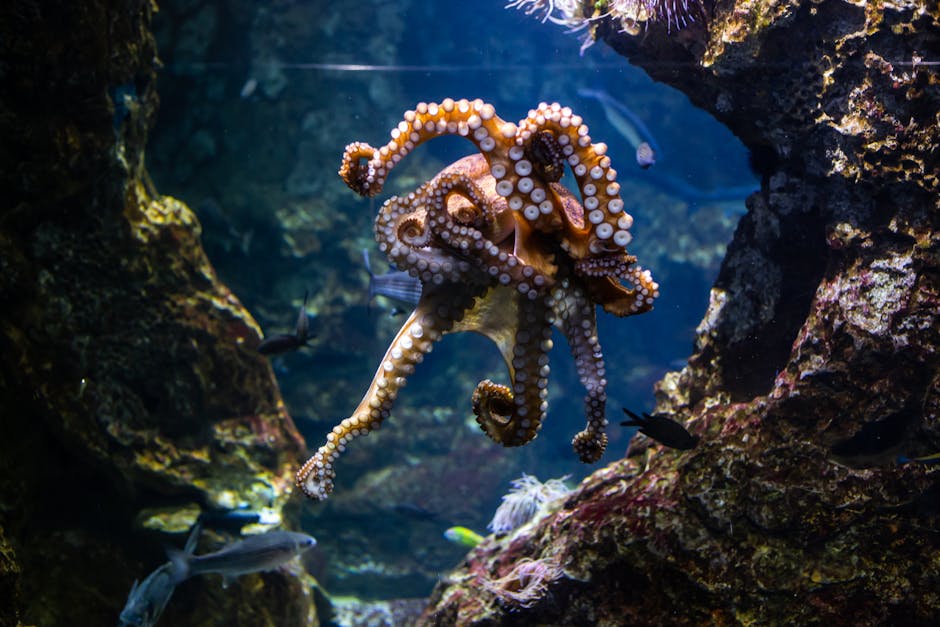
The arm is already moving when the dish lid comes off, curling, probing, pressing suckers against the glass, then pulling back from a taste it does not want.
The octopus it belonged to is no longer attached. The central brain is no longer sending commands. The arm still has enough nervous system inside it to reach, grasp, and respond.
That is not a metaphor. Octopus arms contain more neurons across the eight limbs than the animal keeps in its central brain, and each arm carries hundreds of suckers that can taste what they touch.
The result is one of the strangest facts in animal neuroscience: a detached octopus arm can keep behaving like a searching limb for close to an hour after separation.
The numbers inside an octopus arm
An octopus has roughly 500 million neurons, a count often compared with a dog, but the distribution is unlike the nervous system of a vertebrate. Most of those neurons are not centralized in the head.
Across the eight arms, the animal carries more neurons than it does in the central brain, giving each limb a large local nervous system of its own. That is why the old shorthand that an octopus has “nine brains” survives, even though the biology is more complicated than the phrase suggests.
The suckers add another layer. A review in Frontiers in Physiology notes that a single octopus sucker has about 10,000 chemoreceptor cells, far more than the roughly 100 reported for a cuttlefish sucker.
That is the key correction to the usual viral version of the fact. It is not around 10,000 chemoreceptors per arm. It is about 10,000 chemoreceptor cells in a single sucker, and each arm carries hundreds of suckers.
How the suckers taste by touch
In 2020, a Harvard team led by Nicholas Bellono described the molecular system behind this taste-by-touch ability in Cell. Octopus suckers contain specialized chemotactile receptors that respond to chemicals on surfaces.
That matters because an octopus often hunts where eyes are not enough. It pushes arms into crevices, under rocks, and through cluttered seafloor spaces where prey, predators, and warning chemicals may be felt before they are seen.
The Harvard work showed that octopus suckers can detect contact-dependent chemical cues and route that information into the peripheral nervous system of the arm. The signal does not have to be interpreted only by the central brain.
To the animal, a sucker is not just a suction cup. It is a gripper, a fingertip, and a tongue pressed into one living disk.
Why a detached arm keeps responding
The arm’s autonomy comes from the axial nerve cord, the large neural trunk running down the center of each limb. In octopuses, that cord is not a simple cable.
A University of Chicago team led by Cassady Olson, Grace Schulz, and Clifton Ragsdale mapped the arm circuitry in the California two-spot octopus, Octopus bimaculoides. Their Nature Communications paper found that the axial nerve cord is segmented along the arm.
The university’s own summary of the work describes neuronal cell bodies packed into columns, separated by septa where nerves and blood vessels exit toward muscles. Those segments give the arm a repeated local control architecture.
“Thinking about this from a modeling perspective, the best way to set up a control system for this very long, flexible arm would be to divide it into segments,” Olson said. “There has to be some sort of communication between the segments, which you can imagine would help smooth out the movements.”
That is why the dish experiment works at all. A severed arm has lost the animal, but it has not lost every controller, every receptor, or every local circuit needed to respond.
The map for every sucker
The Chicago team also found that nerves serving the suckers exit through the septa and connect in a systematic pattern. In the primary paper, the authors call this spatial map a “suckerotopy”.
The map preserves information about where each sucker is sending and receiving signals. That is important because octopus suckers do not simply stick to surfaces. They can change shape, sample chemistry, and help move objects from one part of the arm to another.
When Olson applied the same approach to longfin inshore squid, Doryteuthis pealeii, the segmentation appeared in sucker-bearing regions but not in the smooth stalks of the tentacles. The club at the end was segmented. The stalk was not.
That difference fits the animals. Squid hunt in open water and rely heavily on vision. Octopuses prowl the seafloor with arms that behave like sensory search tools.
Why engineers keep looking at octopuses
The octopus arm is a living answer to a robotics problem. How do you control a long, flexible, sensor-heavy appendage without routing every tiny decision through one central processor?
The biological answer is to push control outward. Give the limb local sensing, local motor control, and enough communication with the central brain to follow intent without asking permission for every motion.
That is why octopus arms keep appearing in soft-robotics research. Reviews of octopus-inspired technical systems describe the animal as a model for flexible manipulators, soft grippers, underwater robots, and decentralized control.
The same biology also matters to regeneration researchers. Work on Octopus vulgaris has linked arm development and regeneration with acetylcholinesterase expression, including in a Molecular Neurobiology paper on arm morphogenesis.
That does not mean octopus biology is ready to become a medical product. It means the animal gives researchers a rare natural system where nerves, muscles, suckers, skin, and local control can be damaged and rebuilt with surprising precision.
For Growth List readers tracking commercial angles, the relevant market is not “octopus startups.” It is the cluster of soft robotics, prosthetics, underwater inspection, surgical tools, and sensor companies trying to solve the same control problem with engineered materials.
Teams working in those areas often sit near university labs, marine-biology programs, robotics institutes, and government-funded engineering centers. They also show up in the same places Growth List tracks: startup intelligence, funding-stage research, and sales outreach for highly technical buyer sets.
The arm in the dish is not thinking like a whole octopus. It is doing something narrower and stranger, running local programs through living tissue that still has receptors, muscles, and segmented nerve cords intact.
For nearly an hour, the limb keeps sampling the world. Sucker by sucker, segment by segment, it presses against glass and food and bitter surfaces, acting out the last local instructions of a nervous system that was never entirely in the head.
Get a complete database of newly funded startups delivered every week, with verified decision-maker contacts. Get Leads Every Week